What really happened on 14th August 2025, at 12:30 PM in Chahsoti, Kishtwar district, 90 km from far away Paddar,— when a clear, sunny day suddenly turned into a nightmare of destruction?
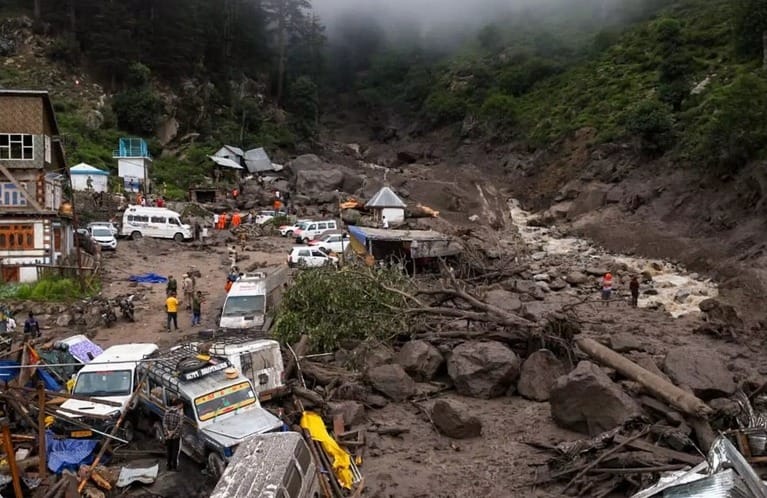
Chahsoti, affected area in cloud brust in Kishtwar district, 90 km away from Paddar, Jammu &Kashmir photo by ANI
Why did this disaster happen on that day?
Everything is planned by God, but what is striking is that at that particular time — around 12:30 PM — a large number of devotees were en route to Machail, while some were returning home after taking blessings from Maa Chandi Mata, the Hindu goddess.
Suddenly, a cloudburst struck in the upper reaches of ChashotiNala. People were standing on the bridges, and dozens were eating langar in the shed. Around 300–400 devotees were present at the time of the incident.
Nobody was aware of the approaching disaster. The weather was totally clear, no rain was forecasted, and the day was bright and sunny.
“When nature strikes without warning, it reminds us how fragile life is — and how human actions may be making such disasters more frequent.”
Then why did this cloudburst happen on that day?
Let’s check the facts.
The Machail Yatra started in the 1980s–2000,s, when only around 20,000 to 50,000 devotees gathered there. But after this holy place gained popularity, the number of devotees increased massively. In the months of July and August — the peak monsoon season in India — lakhs of people thronged the area.
Can such a fragile mountain region handle this sudden human pressure?
Because of the growing crowds, many new infrastructure developments came up near Chahsoti Nalla — shops, langar sheds, and hotels. These constructions caused serious disturbance to the natural ecosystem.
At an elevation of 9,500 feet above sea level, the region is highly vulnerable. When nature’s balance is disturbed, disasters are bound to strike.
How Does a Cloudburst Happen?
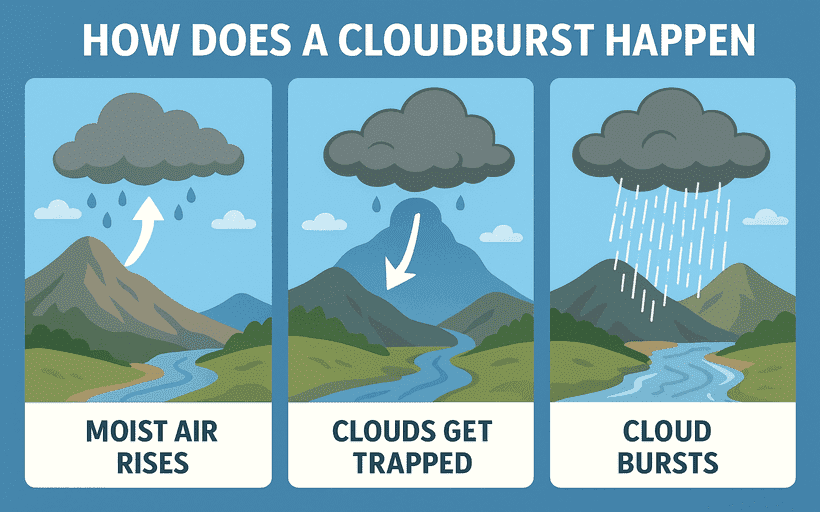
Cloud Brust formation
Cloudbursts are sudden and intense rainfall events that usually occur in mountainous regions. They happen when clouds become overloaded with moisture and release it all at once in a concentrated area, causing destruction within minutes.
The process begins when water evaporates from seas, rivers, and land, rising into the atmosphere to form clouds. These clouds are carried by winds toward the Himalayan region. In high-altitude areas, the moist air is pushed upward quickly. As it rises, it cools, condenses, and forms thick, moisture-laden clouds.
If these clouds get trapped in a narrow valley or cannot move further, the water content builds up inside them. When the clouds can no longer hold the moisture, they burst — unleashing a sudden downpour over a very small area. This is what we call a cloudburst.
In recent years, human activity has added more stress to this fragile balance. Deforestation, unplanned construction, climate change, and heavy seasonal gatherings of people are disturbing the natural ecosystem. These factors lead to higher temperatures, unstable air circulation, and greater chances of extreme weather events.
“At elevations like 9,500 feet above sea level, even the smallest disturbance in nature can trigger a disaster. Cloudbursts are no longer only natural events — they are increasingly influenced by human actions.“
How Can Cloudburst Tragedies Be Prevented?
- Protect nature: Stop deforestation & unplanned construction.
- Smart planning: No buildings near rivers/streams, stronger drainage.
- Early warning: Weather stations, alerts, satellite monitoring.
- Community safety: Disaster drills, limit crowding, safe shelters.
“Nature cannot be controlled, but human actions can. The Chashoti cloudburst is a reminder: if we disturb the mountains, they will answer back. Protecting nature is protecting ourselves.“
Share Your Thoughts
If you liked this news article, please leave a comment. Your feedback motivates us to create more such content. It takes time and effort to build these posts, and your one comment can motivate us more.

Follow the news on WeatherWatch – stay safe, stay updated.
Hello! Do you use Twitter? I’d like to follow you if that would be okay.
I’m absolutely enjoying your blog and look forward
to new posts.
my webpage Best SEO Backlink Services
“Hi Demy, thank you so much for your kind words. I truly feel humbled and grateful. We’re excited to join Twitter soon, but until then, you’re most welcome to follow us on Facebook and Instagram.”