
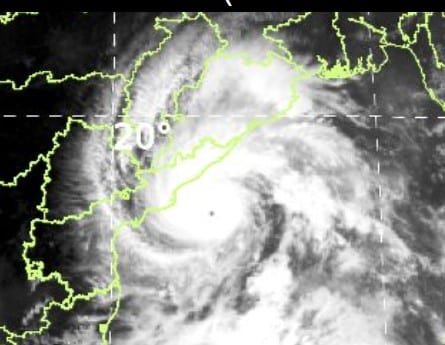
Cyclone Arnab intensified into a Very Severe Cyclonic Storm over the west-central Bay of Bengal and made landfall over the Andhra Pradesh and Yanam coasts on 28 October. The storm crossed the coast between Bapatla and Visakhapatnam, close to Yanam, during the early hours of Wednesday.
The system brought destructive winds, extremely heavy rainfall and coastal flooding to parts of Andhra Pradesh and neighbouring Odisha. Authorities had stepped up emergency preparations in advance, and residents in vulnerable areas followed official warnings and evacuation instructions.
Cyclone Arnab: Landfall details
According to the India Meteorological Department (IMD), Cyclone Arnab intensified over the west-central Bay of Bengal after moving west-northwestwards. On 27 October, the storm was located approximately 260 km southeast of Visakhapatnam and 300 km east-southeast of Kakinada.
The system continued moving west-northwestwards before turning towards the coast and completed landfall in the early hours of 28 October.
Key details include:
- Storm category: Very Severe Cyclonic Storm.
- Landfall location: Between Bapatla and Visakhapatnam, close to Yanam (near Narsapur)
- Landfall timing: Early hours of 28 October (approximately 2 AM to 8 AM IST)
- Maximum sustained wind speed: 125–135 km/h
- Wind gusts: Up to 150 km/h
After crossing the coast, the cyclone weakened steadily while moving inland.
Heavy Rainfall and Impact on Andhra Pradesh and Odisha
Cyclone Arnab produced intense rainfall, localised flooding and strong winds across coastal Andhra Pradesh and southern Odisha. Several districts recorded extremely heavy rainfall, leading to waterlogging, damage to crops, uprooted trees, and disruption of power and communication networks.
Low-lying areas and poorly drained settlements were particularly affected. Flooding disrupted road travel in multiple locations, and electricity supply was interrupted in large parts of the coastal belt.
Southern Odisha also experienced heavy rain and strong winds as the system moved inland.
Rainfall may overwhelm local drainage systems, particularly in low-lying settlements. Flooding could disrupt road travel, damage crops and affect electricity supplies. People living near rivers, streams and poorly drained urban areas should remain alert to rapidly changing conditions.
Government Response and Preparedness
The National Crisis Management Committee had reviewed preparations for Cyclone Arnab on 26 October. State governments arranged shelters, evacuation plans, emergency response teams and district control rooms in advance.
National and state disaster response teams were placed on standby and later deployed for rescue and relief operations across Andhra Pradesh, Odisha and adjoining regions.
Fishermen had been advised not to venture into the Bay of Bengal along the Andhra Pradesh, Odisha and Yanam coasts during the warning period.
New System Developing in Bay of Bengal
Meanwhile, a fresh Well Marked Low Pressure Area has formed over the southeast Bay of Bengal and adjoining Andaman Sea. According to the IMD, it is likely to concentrate into a Depression within the next few hours and may further intensify into a Cyclonic Storm. The system is expected to move west-northwestwards and reach near the Andhra Pradesh coast around the evening of 2 November 2026.
WeatherWatch is closely monitoring this system and will provide further updates.
Sources: India Meteorological Department (IMD); Press Information Bureau, Government of India.