
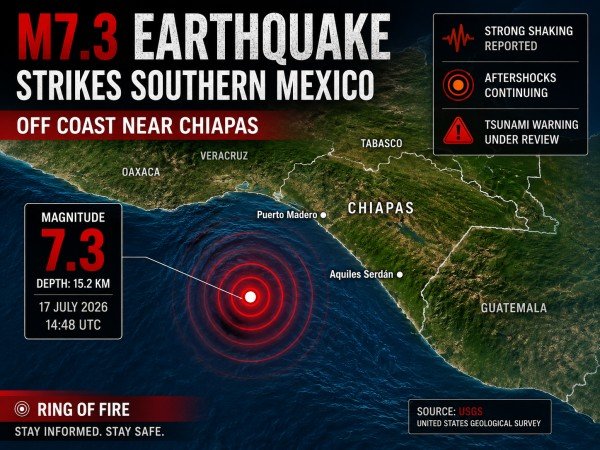
A magnitude 7.3 earthquake struck offshore near the southern coast of Chiapas, Mexico, on 17 July 2026, according to the U.S. Geological Survey (USGS). The shallow earthquake occurred in the Pacific Ocean southwest of Aquiles Serdán and was widely felt across southern Mexico and parts of Guatemala.
Authorities began assessing the affected areas soon after the earthquake. At the time of publication, officials were also monitoring the possibility of tsunami impacts and the likelihood of additional aftershocks.
What Happened?
The earthquake occurred at 20:18:39 (UTC+5:30), equivalent to 14:48 UTC, with an estimated depth of 15.2 kilometres. USGS identified the epicentre about 48 kilometres southwest of Aquiles Serdán, Chiapas.
Initial automatic solutions briefly estimated the earthquake at magnitude 7.4. However, after additional seismic data became available, USGS revised the magnitude to 7.3, which is a common practice following large earthquakes.
Because the earthquake occurred offshore along the Middle America Trench, strong shaking was reported across parts of southern Mexico. Residents in several communities evacuated buildings as a precaution while emergency agencies evaluated potential damage.
Shortly after the mainshock, multiple aftershocks occurred in the same region. One of the strongest measured magnitude 5.3, indicating that the fault system remained active following the initial rupture.
As of publication, authorities had not released a final assessment of structural damage or confirmed casualty figures. Emergency response teams continued inspections in affected communities.
Safety Advisory
People living in coastal areas of southern Mexico should continue following updates from local civil protection agencies and tsunami warning authorities.
If strong shaking occurs:
- Drop, cover and hold on until the shaking stops.
- Stay away from damaged buildings.
- Expect additional aftershocks.
- Avoid coastal areas if tsunami advisories remain in effect.
- Follow official instructions before returning to evacuated locations.
Emergency agencies remind residents that aftershocks can occur for hours or even days after a major earthquake.
What Happens Next?
Seismologists will continue analysing the earthquake sequence as additional seismic data become available. The magnitude, depth and fault mechanism may be refined through further review.
Authorities are also expected to continue inspecting roads, bridges, public infrastructure and coastal communities. Any confirmed reports of damage, injuries or tsunami impacts will be released through official government channels.
Scientists note that earthquakes cannot be predicted. However, aftershock activity is a normal part of the earthquake cycle following an event of this size.
Residents are encouraged to rely on official information from USGS, Mexico’s National Seismological Service and local emergency management agencies for verified updates.
Frequently Asked Questions
Where did the earthquake occur?
The earthquake struck offshore in the Pacific Ocean approximately 48 km southwest of Aquiles Serdán, Chiapas, Mexico.
Why was the magnitude changed from 7.4 to 7.3?
Large earthquakes are initially calculated using limited data. As more seismic stations report, scientists refine the measurements, which can result in slight magnitude adjustments.
Are aftershocks expected?
Yes. Aftershocks are common after large earthquakes and may continue for several days or weeks.
Was a tsunami confirmed?
Authorities monitored tsunami conditions following the earthquake. Residents in coastal areas should continue following official advisories for the latest information.
Conclusion
The M7.3 Mexico earthquake is one of the strongest seismic events recorded in the region this year. Although the earthquake caused strong shaking across southern Mexico, officials continue assessing its impacts while monitoring aftershock activity and coastal conditions. Residents should stay informed through official sources and remain prepared for further seismic activity.
Follow WeatherWatch for satellite-backed alerts and IMD-verified data, posted before mainstream news: 📸 Instagram: @weath_erwatch 🌐 Website: weatherwatch.in